

10 Apr A Brief History of the Thomas-Kilmann Conflict Mode Instrument
(Longer Version)
by Ralph H. Kilmann
…
…
FIRST CONTACT
In the fall of 1970, I entered the doctoral program in UCLA’s Graduate School of Management. I chose to major in the behavioral sciences. During my first year in the program, with the ten other entering students in the same major, I was required to take a twenty-four-credit seminar, “Foundations in the Behavioral Sciences,” which was team-taught by five faculty members. That’s how I met Kenneth W. Thomas. Aside from teaching at UCLA, he was also completing his Ph.D. degree from Purdue University. Naturally, at this time, we had no idea that the seeds, which would set in motion the entire history of the Thomas-Kilmann Instrument, had just been silently planted in the scientific soil.
That twenty-four-credit seminar met nine hours every week, from October 1970 to April 1971. Week by week, I developed a keen interest in designing quantitative assessments of human behavior, which required me to learn more about the validity and reliability of assessments. Based on this knowledge, I then designed a projective measure of interpersonal values, which ultimately became the topic of my doctoral thesis (Kilmann, 1972).
While we, the students, diligently pursued our research studies, the five instructors of the seminar regularly updated us on their own projects, which covered a range of topics. But I was particularly fascinated with Ken’s interests. Besides finishing up his dissertation on conflict modes and interdepartmental conflict (Thomas, 1971), he was also writing a chapter, “Conflict and Conflict Management,” for an important handbook in the field (Thomas, 1976).
DISSATISFACTION WITH EXISTING INSTRUMENTS
In our discussions both inside and outside of class, Ken regularly expressed dissatisfaction with the way conflict-handling behavior was assessed in research studies—based on his doctoral thesis. Blake and Mouton (1964) had developed the original instrument to measure the five modes: Their assessment consisted of five statements, each describing one of the modes. In the original version, respondents were asked to simply pick the one statement that best described their usual behavior. In subsequent uses of the instrument, respondents were asked to rank order the five statements (from “1” for highest to “5” for lowest), according to how well each one captured how they usually approach conflict situations. But from the way the five statements were worded, it was obvious that “collaborating” was the ideal mode, while “avoiding” was the least desirable one. Sure enough, that’s exactly how managers rated themselves, with over 90% ranking themselves highest on collaborating and lowest on avoiding. Their subordinates, of course, experienced those same managers very differently.
By the time the doctoral seminar concluded in April 1971, I’d already made substantial progress on learning about instrument methodology (including the whole host of response biases, including social desirability) and then applying that knowledge to my assessment of interpersonal values. From Ken, I had learned a lot about conflict theory and more about the social desirability response bias. While I don’t recall if there was a single moment, an epiphany of sorts, but at some point Ken and I must’ve said out loud: “Let’s develop a new instrument to measure the five conflict-handling modes.” The history of the Thomas-Kilmann Instrument had officially begun!
THE WORK ON THE TKI BEGINS
Since Ken’s chapter for the handbook had reinterpreted Blake and Mouton’s framework—from the independent dimensions of “concern for production” and “concern for people” to the independent dimensions of assertiveness and cooperativeness, respectively, we naturally proceeded with his revised model for defining the five modes: competing, collaborating, compromising, avoiding, and accommodating. We also made good use of the chapter I was preparing for my dissertation, which summarized and integrated the major works on instrument methodology and response biases.
From the start, Ken and I knew that the biggest challenge for designing a better instrument to measure conflict-handling behavior was to overcome the social desirability bias: people’s tendencies to present the most socially acceptable image of themselves, rather than present themselves as they really are. That bias is what plagued the Blake and Mouton instrument, as well as the two other conflict-handling instruments: Lawrence and Lorsch (1967) and Hall (1969).
Addressing the Social Desirability Response Bias
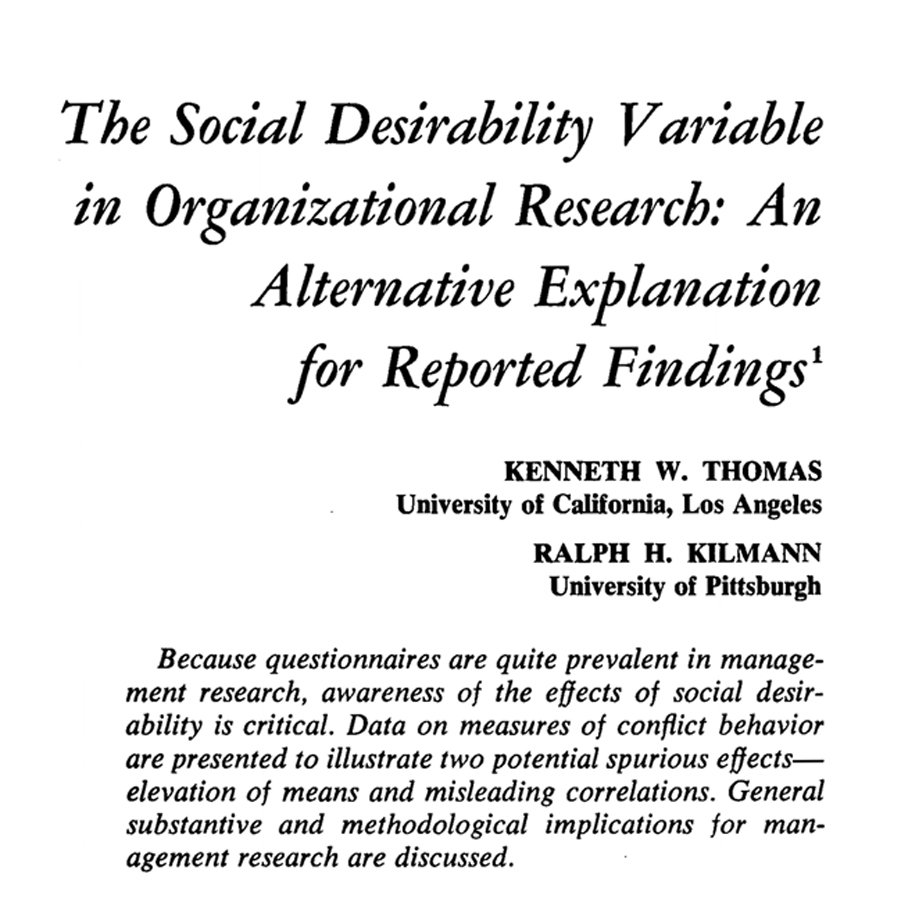
How did we minimize the social desirability bias for our new conflict instrument? In a nutshell, Ken and I created thirty pairs of statements. For each pair, the respondent has to choose either the A or B item (for example, one item depicts collaborating while the other item describes avoiding). But each pair of statements was specifically designed—through a multi-stage research process—to be equal in social desirability (for example, “I attempt to get all concerns and issues immediately out in the open” versus “I try to postpone the issue until I have had some time to think it over”). Since each pair of items on the TKI is equal in social desirability (and thus each item in a pair will make a person feel equally desirable to himself and others), a person has to choose each item based solely on its content (whether he usually relies on avoiding over competing, and so forth.). Ken and I thus made it very difficult for people to choose items to make themselves look good; instead, they have little choice but to indicate how they actually behave in conflict situations. We published our findings in a research article that provided strong evidence that our approach reduced the social desirability bias from an average of over 90% on the previous three assessments of those five conflict modes to 17% on our new TKI assessment tool (Thomas and Kilmann, 1975):
There is a nice byproduct of this procedure for dramatically reducing the social desirability response bias: The forced-choice design conveniently measures the relative frequency of respondents choosing one mode over another. It was apparent to Ken and me that people don’t use several modes at the same time (which would be measured, ironically, if there wasn’t a forced-choice or similar format on a conflict assessment). Instead, people habitually use one mode more than another and that is precisely what we sought to measure with our Conflict Mode Instrument (which is nicely achieved within a forced-choice format). As such, the history of the Thomas-Kilmann Instrument was unfolding very nicely.
Making a Big Decision
In 1973, Ken and I completed our research article about the development and validation of our conflict instrument, which we planned to submit to an academic journal. But we faced a dilemma: Should we include the TKI in the appendix of our article (which would limit its exposure to other researchers and professors)? Or should we try to get the TKI published as a stand-alone assessment tool (which could bring the TKI to a much larger audience in business, education, and government)?
At one point in this decision-making process, Ken, as a newly appointed assistant professor, decided to ask a distinguished professor in marketing about our predicament. Dr. Hal Kassarjian gave Ken this advice: “Don’t be ridiculous. Only researchers are likely to use your thirty-item questionnaire. Put it in the appendix of your article and be done with it.” If Ken and I had done what was being suggested to us, however, the history of the Thomas-Kilmann Instrument might have been cut short by that decision.
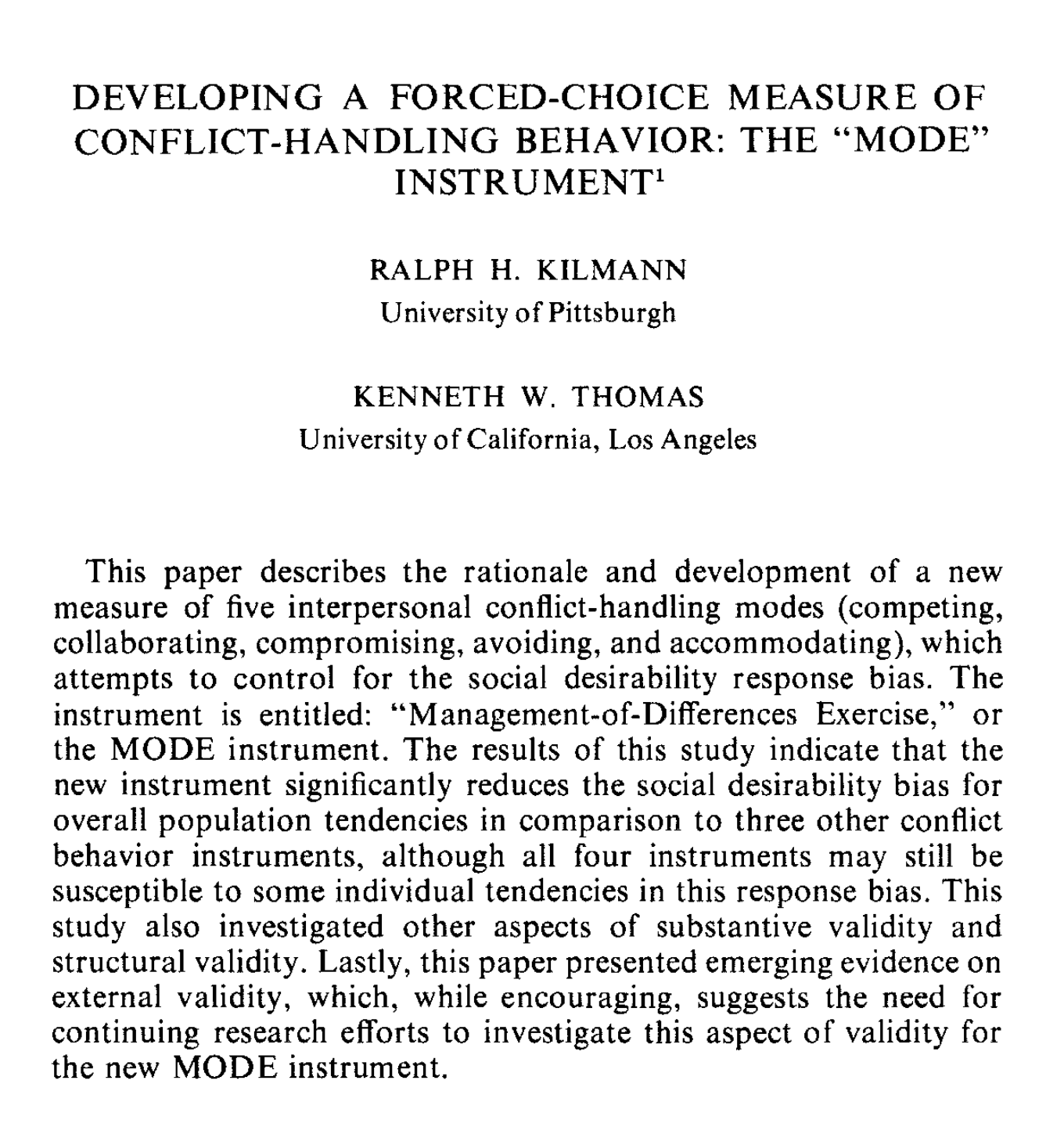
But a few months later, Dr. Warren Schmidt, the Director of Executive Development at UCLA, asked Ken to help him develop some course materials for a training program on conflict management. The work was being sponsored by a publishing company in New York: Xicom, Inc. During one of Ken’s visits to Xicom, he brought along a copy of the TKI and asked if they might be interested in publishing it as a management training tool. Because of Xicom’s positive response, Ken and I signed a formal contract with our new-found publisher, but we did not include our instrument in the appendix of our forthcoming article on developing and validating the TKI assessment tool (Kilmann and Thomas, 1977). With that timely decision, the history of the Thomas-Kilmann Instrument had just taken a crucial step forward.
Xicom Publishes the TKI
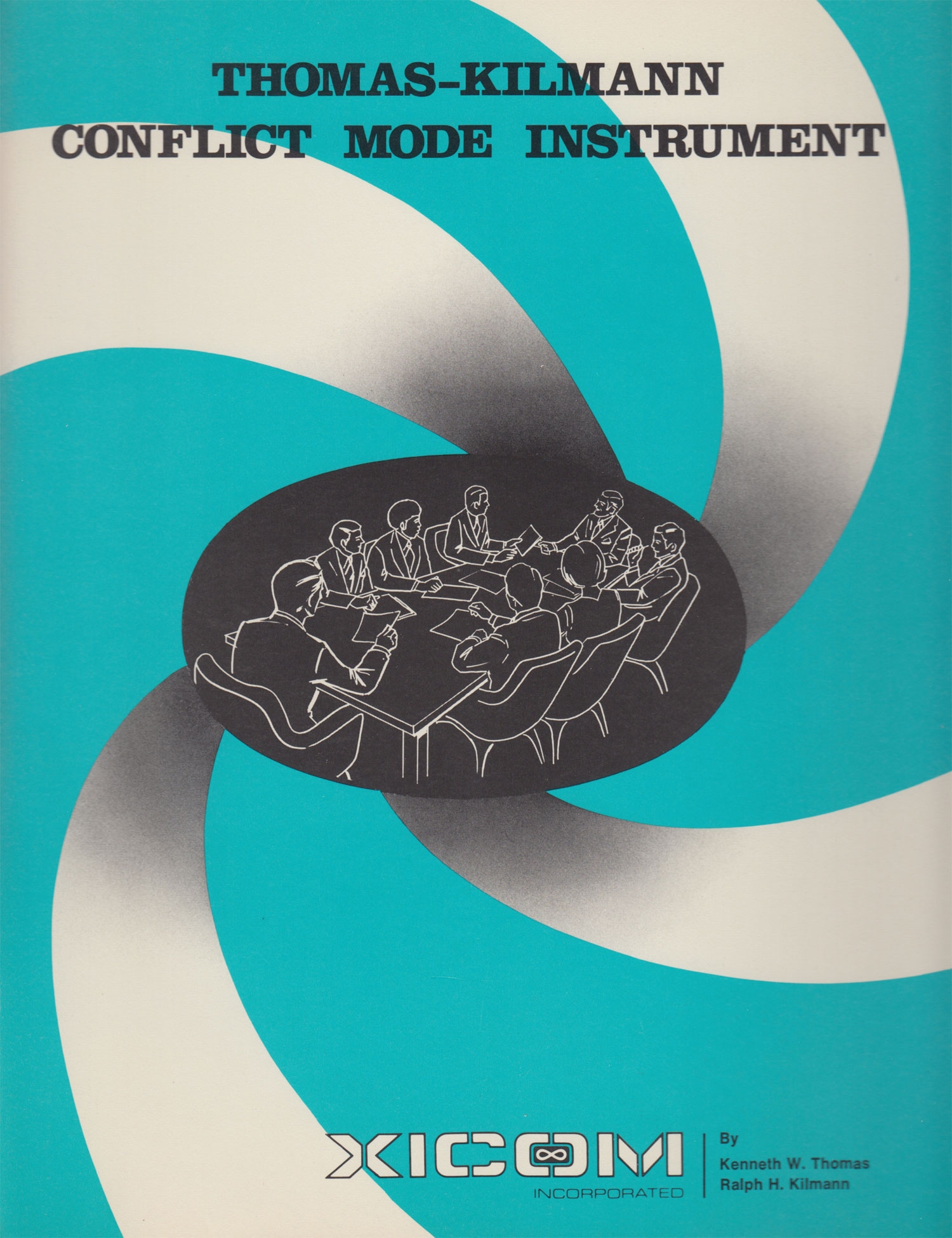
In 1974, Xicom published the TKI as a sixteen-page booklet. Along with the thirty pairs of items and a self-scoring page, respondents could also graph their scores in comparison with a normative sample of 339 middle and upper managers in government and business. In this way, respondents could learn if any of their scores were relatively high (in the top 25%) or low (in the bottom 25%), thereby suggesting which modes they might be using too much or too little, as compared to our normative sample. The TKI booklet also helps respondents interpret their scores by (1) suggesting when each mode is most useful in a work situation and (2) asking a series of developmental questions for respondents who scored high or low on a particular mode.
ADDRESSING CRITICISMS: AN ONGOING PROCESS
By the late 1970s, we started receiving a few complaints from customers about the TKI’s exclusive use of male pronouns. At first, since only five of the thirty pairs of statements included a “he,” “his,” or “him” in one of the A/B choices, we weren’t particularly concerned. But by the early 1980s, the frequency of complaints about “the masculine bias” gradually increased. Consequently, by the mid-1980s, the use of the male pronouns on five items was changed to he/she, his/hers, or him/her, which easily resolved the gender issue. As such, the history of the Thomas-Kilmann Instrument had just embraced gender equality—at least for the time being.
In the late 1980s, another criticism developed, which concerned the small (and demographically limited) sample that had established our conflict-handling norms. Recall: We sampled only 339 middle and upper-level managers in business and government. Although not reported at the time, Ken and I knew that our sample from the 1970s was predominately white male and highly educated, which was, of course, very different from the increasingly diverse U.S. workforce. But at the time these complaints were surfacing, we were already busy with other research projects: He was studying empowerment and intrinsic motivation, while I was exploring corporate culture and transformation. So we decided to live with the limited norm sample, even though we continued to use the TKI in our university teaching and consulting work.
CPP Acquires Xicom
In 1998, Xicom, Inc. was acquired by CPP, Inc. in Mountain View, California, the publisher who now distributes the TKI throughout the world, along with its other well-known instruments, including the Myers-Briggs Type Indicator, the Strong Interest Inventory, and the FIRO-B. Not surprisingly, this ownership change turned out to be a pivotal step in the unfolding history of the Thomas-Kilmann Instrument.
Soon after the acquisition, the TKI booklet was printed in full color and translated into Spanish, French, and Portuguese.
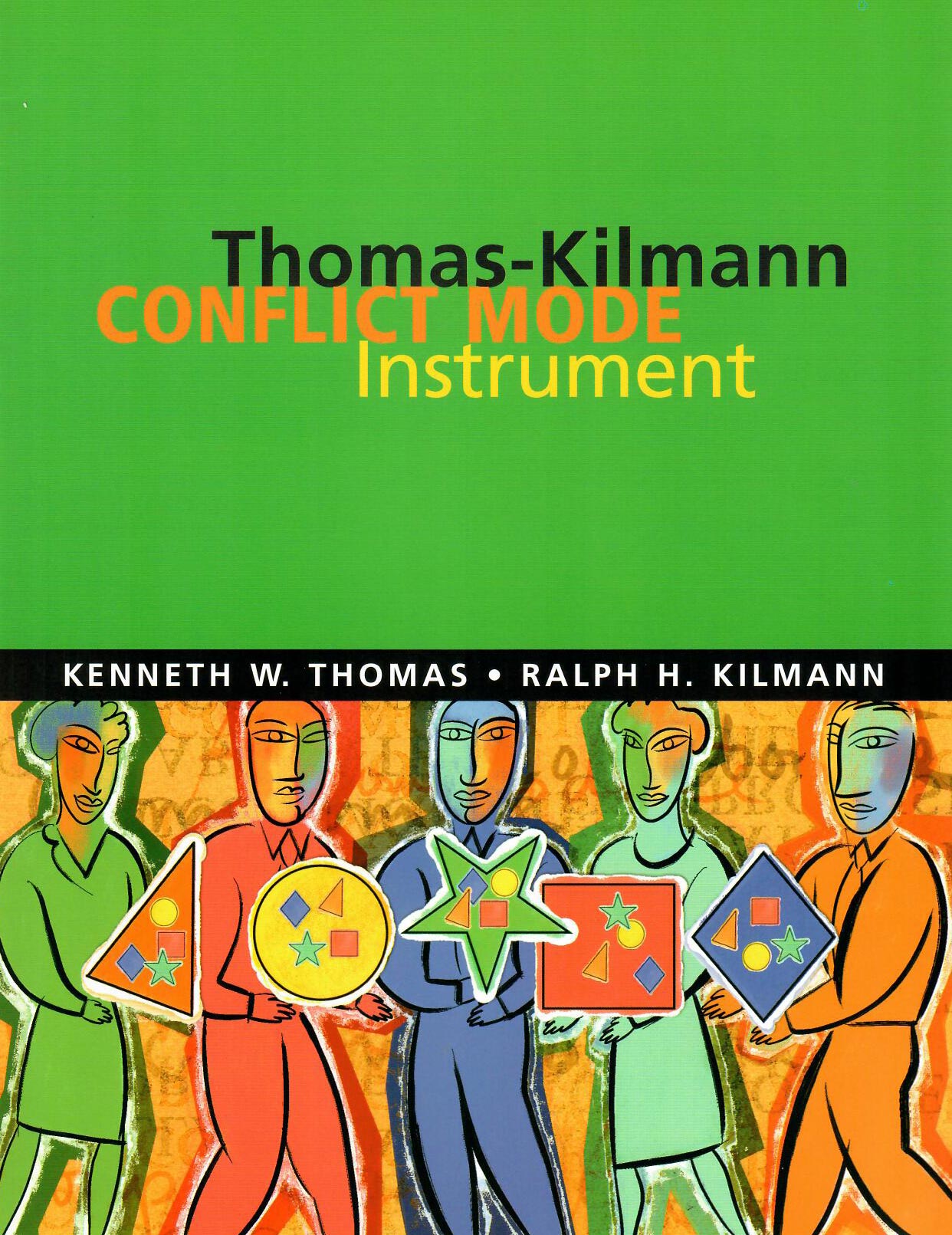
Nevertheless, we continued to get complaints about the limited sample that was still being used to categorize whether a person scores high, medium, or low on each conflict mode. With the new developments of the World Wide Web, CPP put the TKI online in 2002, which provided computer-generated scores and instantly graphed the results on screen. Conveniently, this online service, SkillsOne, enabled CPP to gather extensive data from a diversified sample of respondents—which set the stage for finally updating the TKI norms from the 1970s to the 2000s.
Using SkillsOne to Update the U.S. Norm Sample
After 59,000 people had taken the TKI through SkillsOne (which, by design, also collected a wide array of demographic information), CPP’s research department created a randomized sample of 4,000 men and 4,000 women—stratified by race/ethnicity, age, organizational level, and geographical region in order to mirror the U.S. workforce. In 2007, the full report was prepared by Nancy A. Schaubhut and then published by CPP: Technical Brief for the Thomas-Kilmann Conflict Mode Instrument: Description of the Updated Normative Sample and Implications for Use.
Although Ken, I, and the people at CPP were fully prepared to offer different respondents a different normative profile (based on gender, race/ethnicity, age, level, and region) in order to categorize their scores as high, medium, or low, that didn’t turn out to be necessary. CPP’s extensive research study resulted in two big surprises: (1) there were no significant differences, practically speaking, in the conflict norms across all demographic distinctions and (2) there were negligible changes in the norms from the 1970s to the 2000s.
Regarding the first surprise, we found it amazing that demographic differences had no practical significance on conflict norms (even though there were statistically significant differences due to the very large number of respondents in the SkillsOne sample). This practical finding is all the more striking since the demographic profile of the U.S. workforce has changed so dramatically in the past thirty years—particularly with the large influx of women and minorities into the workplace. The way people handle their differences, however, has stayed pretty much the same (practically, not statistically, speaking), independent of gender, race/ethnicity, age, organizational level, and geographical region.
Regarding the second surprise, out of a total of fifteen norms for the TKI (the three categories of high, medium, and low scores for five conflict-handling modes), seven norms stayed exactly the same, while the other eight norms changed by only one number on the assessment. For example, instead of the top 25% of compromising scores ranging between 9 and 12 on the original norms, the top 25% varies between 10 and 12 on the revised norms. Of the other norm categories that changed, they also shifted by only one number. This finding solidified the long-term stability of conflict-handling behavior in the United States, which became another key step in the unfolding history of the Thomas-Kilmann Instrument.
In sum, although experience shows that there are striking differences in behavior between male and female, black and white, young and old, non-supervisory personnel and top-level executives, and southerners and mid-westerners—conflict-handling norms are pretty much the same across these demographic distinctions and have remained largely the same for the past thirty years. Little did Ken and I know that our 1970s’ homogeneous sample of 339 managers would indeed result in the same norms as the 2000s’ diversified sample of 8,000 respondents. Perhaps the one behavior that helps define the essence of the U.S. culture is the way that its citizens—across the board—handle conflict situations.
With these minimal changes in norms for the TKI, it was easy to redo the one page in the instrument that profiles a respondent’s results into high, medium, and low scores. And we can now say, with confidence, that the TKI’s normative profile is based on a large, diverse, and up-to-date sample of respondents.
Using SkillsOne to Develop Cross-Cultural and Multi-Language Norm Samples
But two questions have been increasingly asked about the English TKI assessment: Is this instrument unique to the U.S. culture? Can it be effectively applied to other countries and languages? These issues are even more important to address now that the TKI is available in several languages: Spanish, French, Portuguese, Danish, Dutch, Swedish, Japanese, and Chinese (both traditional and simplified). Thus, an exciting moment in the history of the Thomas-Kilmann Instrument was when we were able to explore its use well beyond the U.S. borders.
In 2008, CPP, Inc. partnered with OPP in Europe and Fellipelli in Brazil to publish its first international study of culture and conflict: Workplace Conflict and How Business Can Harness It to Thrive. By collecting data in nine countries (United States, Belgium, Brazil, Denmark, France, Germany, Ireland, the Netherlands, and the United Kingdom), this technical report examines the global causes—and costs—of conflict in the workplace.
Although this international study on conflict management didn’t make use of the TKI to assess specific modes and how they vary from country to country, as more and more people began using CPP’s SkillsOne platform to respond to the TKI, it soon became possible to explore the TKI norms across different countries and languages.
In 2011, Herk and associates authored CPP’s report: International Technical Brief for the Thomas-Kilmann Conflict Mode Instrument. This exploratory study, using the TKI assessment in English (as the international business language), included 6,168 individuals who were residing in 16 countries: Australia, Brazil, Canada (two samples—English speakers and Canadian French speakers), People’s Republic of China, France, Germany, India, Republic of Ireland, Italy, Japan, Mexico, New Zealand, Singapore, South Africa, Sweden, and the United Kingdom. Almost all participants responded to a number of demographic items prior to taking the TKI assessment. These items pertained to organizational level, employment status, age, gender, years working in current occupation, and satisfaction with current occupation.
While the U.S. Norm Sample was specifically developed to mirror the racial and ethnic distribution of the U.S. workforce, individual international samples that were included in the international study were nearly all samples of convenience. Recall: The U.S. Norm Sample of 8,000 respondents was drawn, via a stratified random sample, from a much larger pool of 59,000 online respondents. Therefore, the high, middle, and low scores in the U.S. Norm Sample percentiles represented those national demographic features. The international samples, on the other hand, varied in size, with eight countries having fewer than 200 participants. These smaller samples were based on a relatively small number of administrations that tapped different industries and occupations. Moreover, samples from different countries differed in their percentages of women and men, which could have skewed percentiles somewhat. Thus, differences (statistically or practically significant) revealed in these preliminary cultural comparisons may be a result of the different sampling methods that were employed for the U.S. and these International samples.
Nevertheless, the international study suggests that, as a practical matter, the U.S. TKI norms (in particular, the high, medium, and low categories) do not diverge strongly from those of the countries in this study. Thus, both Ken and I, and CPP the publisher, felt comfortable in concluding that the current TKI Profile, using the English version of the assessment, can be used with confidence to interpret results for people of international origin and residence. This became one more important step in the developing history of the Thomas-Kilmann Instrument.
Making further use of the online SkillsOne platform, CPP has published preliminary studies on the translated versions of the TKI assessment. For example, see the 2013 research study on the Japanese translation: Technical Brief for the Thomas-Kilmann Conflict Mode Instrument: JAPANESE. Also see the 2014 research study on 12 additional TKI translations: Technical Brief for the Thomas-Kilmann Conflict Mode Instrument: Global Research Project for Translated TKI Assessments. The latter two research studies (similar to the initial international study using only the English version of the TKI) showed only minor variations in the high, middle, and low percentiles across the TKI translations. Nevertheless, as more and more people respond to the TKI worldwide, CPP’s cross-cultural and cross-language studies will have a more solid basis for determining (1) whether the TKI Profile (based on the U.S. Norm Sample) needs to be modified to suit different countries and languages or (2) if conflict-handling behavior is indeed so similar across globe that what constitutes high, medium, and low scores on the TKI assessment, practically speaking, does not change much at all.
CELEBRATING THE TKI’s 40th YEAR ANNIVERSARY (1974–2014)
 Ken Thomas and Ralph Kilmann
In 2011, with early anticipation of the big event that was just three years away, I wrote an article for CPP: Celebrating 40 Years with the TKI Assessment: A Summary of My Favorite Insights. Then in 2014, CPP followed with its 40th Year TKI Infographic, which provided additional articles, case studies, blogs, and other TKI resources. By mid-2014, CPP produced the first TKI Whiteboard Annination and a Series of Six Short Videos, in which I address the special features of the TKI assessment. As the anniversary year was coming to a close, I wrote an article that added further insight into the surrounding systems that are the major causes of conflict in organizations and how the TKI can be used to resolve those conflicts by self-designing and self-managing the organization’s culture, strategy, structure, and reward system: Celebrating the Thomas-Kilmann Instrument (TKI) and Systemwide Conflict Management. Meanwhile, CPP concluded the anniversary year by publishing the first TKI e-book: The TKI Tool: More Than Conflict Management.
CREATING THE NEW TKI TEAM REPORT
Teams have become the building block of today’s organizations—given the complex problems and the mega conflicts that are increasingly propelled by our highly diverse global village.
As a result of using many more teams in different kinds of ways, researchers have convincingly demonstrated that effective teamwork can increase engagement, boost innovation, and improve productivity for every team member, for the team as a whole, and for the entire organization. Studies show that a team’s ability to manage conflict is one of the most important factors that consistently affect its performance.
Past feedback from TKI users shows that trainers and facilitators have been using the TKI assessment for team-based training by manually creating their own TKI profiles for an intact workgroup. Based on this feedback, Ken Thomas, Gail Thomas, and I decided to create a special purpose The TKI Team Report that will not only automatically calculate a composite TKI Team Profile for a team’s relative use of the five conflict modes, but that same report will also provide a number of individual/team comparisons of the possible overuse and underuse of the five conflict modes. The latter results and accompanying discussion will help team members identify their primary CHALLENGES in managing their team’s daily stream of conflicts as well as provide a number of proven REMEDIES to help team members improve their conflict-handling behavior, and thereby improve their team’s performance and satisfaction.
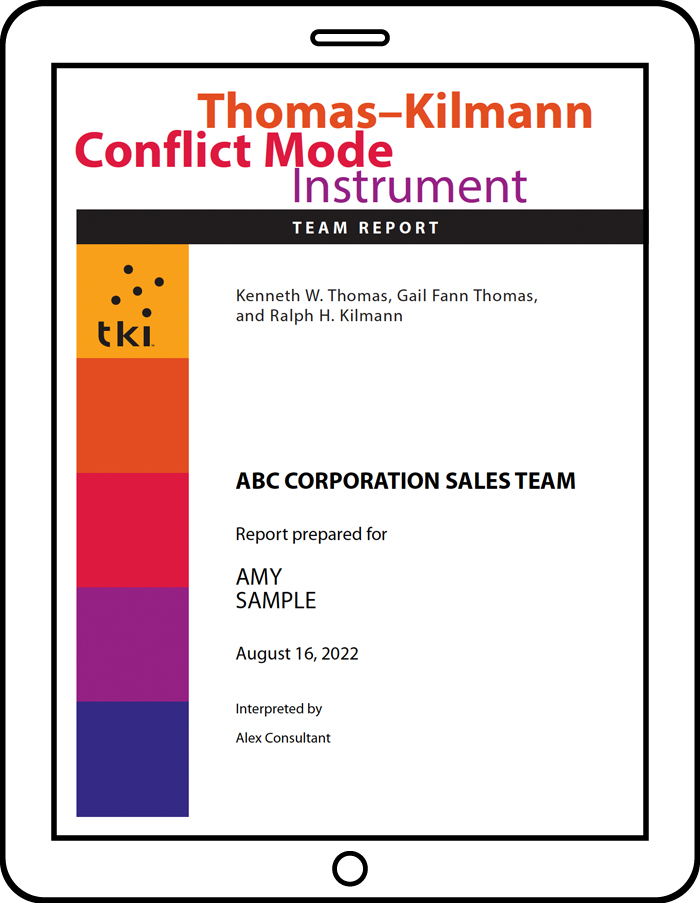
To help you make the best use of the TKI Team Report for couples, families, workgroups, organizations, and cross-boundary project teams, the three co-authors have created a FREE Facilitator’s Guide!
Incidentally, instead of using the general-purpose instructions of the TKI assessment (which do not specify any specific work or other social situation), you can modify the standard instructions so team members will respond to the TKI’s 30 A/B items according to how they respond to conflict inside that specific group—and that group only.
By having each team member focus on the behavior in that team only, the TKI results will be more accurate, since member behavior in OTHER social settings (home, neighborhood, etc.) will not dilute (let alone distort) the intended assessment of that team’s conflict-handling behavior in a very specific setting.
CAUTION: Before you begin using the TKI Team Report with your clients, we recommend that you already are considerably experienced in working with the TKI Individual Report (and thus you know when it’s best to use each of the five conflict modes—and why). Naturally, it would also be beneficial if you have the knowledge and skills to help teams improve their behavior so they can improve their results. Consequently, to ensure that you’ll be using the TKI Team Report effectively, you might want to take either or both of these online courses: (1) BASIC Training in Conflict Management and (2) Team Management Skills Training.
Just below is a 12 minute video that presents why the new TKI Team Report was developed, when to use it instead of relying on the classic TKI Individual Report, and how Kilmann Diagnostics can help you provide the new TKI Team Report to all kinds of groups and teams:
CONCLUSION: THE TKI IN PERSPECTIVE
Looking back at the past fifty-plus years, the TKI was initially conceived when Ken and I met each other at UCLA in 1970—he as a young assistant professor and I as an even younger doctoral student. At that time, we had no idea if our instrument would actually be published outside of our research article. And we certainly never dreamed the TKI would become so widely used in so many different kinds of organizations around the world. As a result, we have remained exceedingly grateful for the excellent work that Xicom once did, and CPP (renamed, The Myers-Briggs Company) is now doing to continue bringing our creation to life. Ken Thomas and I can now look back on the past several decades with much joy, since we fully appreciate the several pivotal decisions along the way that have become the fascinating “brief” history of the Thomas-Kilmann Instrument.
CELEBRATING THE TKI’s 50th YEAR ANNIVERSARY (1974–2024)
AFTERMATH: THE KILMANN ORGANIZATIONAL CONFLICT INSTRUMENT (KOCI)
Directly below, see my 12-minute video presentation that summarizes my latest assessment tool: The Kilmann Organizational Conflict Instrument. This diagnostic instrument has been designed to identify an organization’s systems and processes that are significantly undermining—hence, misdirecting—members’ use of those five conflict modes inside their organization or work unit, so the most troublesome “systems conflicts” can then be transformed to actively support the effective use of all five conflict modes for both organizational success and personal meaning, short term and long term. In essence, the Kilmann Organizational Conflict Instrument fully appreciates that an organization’s systems and processes affect at least 80% of how conflict is addressed and resolved in the workplace, while individual preferences for using certain conflict modes affect, at most, about 20% of the observable conflict-handling behavior and results. With the introduction of the new KOCI instrument, it seems that the history of the Thomas-Kilmann Instrument continues to inspire new theories and new assessment tools for conflict management and change management.
BIBLIOGRAPHY
Blake, R. R., and Mouton, J. S. The Managerial Grid (Houston: Gulf Publishing, 1964).
CPP, Inc. Global Human Capital Report: Workplace Conflict and How Businesses Can Harness It to Survive (Mountain View, CA: CPP, Inc., 2008).
CPP, Inc. Infographic—40 Years of Conflict Resolution: Meet the TKI (Mountain View, CA: CPP, Inc., 2014).
CPP, Inc. The TKI Tool: More Than Conflict Management (Mountain View, CA: CPP, Inc., 2015).
Hall, J. Conflict Management Survey (Conroe, Texas: Teleometrics International, 1969).
Herk, N. A., Thompson, R.C., Thomas, K. W., and Kilmann, R. H. International Technical Brief for the Thomas-Kilmann Conflict Mode Instrument (Mountain View, CA: CPP, Inc., 2011).
Johnson, C. A., Thompson, R. C., and Anderson, M. G. Technical Brief for the Thomas-Kilmann Conflict Mode Instrument: Global Research Project for Translated TKI Assessments (Mountian View, CA: CPP, Inc., 2014).
Kilmann, R. H. The Development and Validation of a Projective Measure of Interpersonal Values (University of California at Los Angeles. Unpublished Dissertation, 1972).
Kilmann, R. H. “Celebrating 40 Years with the TKI Assessment: A Summary of My Favorite Insights,” CPP Author Insights, April 2011.
Kilmann, R. H. “Celebrating the Thomas-Kilmann Conflict Mode Instrument (TKI) and Systemwide Conflict Management” Kilmann Diagnostics Website, 2014.
Kilmann, R. H. The Kilmann Organizational Conflict Instrument (Newport Coast, CA: Kilmann Diagnostics, 2020).
Kilmann, R. H., and Thomas, K. W. “Developing a Forced-Choice Measure of Conflict-Handling Behavior: The MODE Instrument,” Educational and Psychological Measurement, Vol. 37, No. 2 (1977), 309-325.
Kilmann, R. H., Thomas, G. F., and Thomas, K. W. Facilitator’s Guide for the TKI Team Report (Sunnyvale, CA: The Myers-Briggs Company, 2022).
Lawrence, P. R., and Lorsch, J. W. Organization and Environment (Boston: Graduate School of Business Administration, Harvard University, 1967).
Schaubhut, N. A. Technical Brief for the Thomas-Kilmann Conflict Mode Instrument: Description of the Updated Normative Sample and Implications for Use (Mountain View, CA: CPP, Inc., 2007).
Thomas, K. W. Conflict-Handling Modes in Interdepartmental Relations (Purdue University. Unpublished Dissertation, 1971).
Thomas, K. W. “Conflict and Conflict Management,” in M.D. Dunnette (Ed.), Handbook of Industrial and Organizational Psychology (Chicago: Rand-McNally, 1976), 889-935.
Thomas, K. W., and Kilmann, R. H. The Thomas-Kilmann Conflict Mode Instrument (Mountain View, CA: CPP, Inc., 1974).
Thomas, K. W., and Kilmann, R. H. “The Social Desirability Variable in Organizational Research: An Alternative Explanation for Reported Findings.” Academy of Management Journal, Vol. 18, No. 4 (1975), 471-482.
Thomas, K. W., Thomas, G. F., and Kilmann, R. H. The TKI Team Report (Sunnyvale, CA: The Myers-Briggs Company, 2022).
Weber, A. J., Johnson, C. A., and Thompson, R. C. Technical Brief for the Thomas-Kilmann Conflict Mode Instrument: JAPANESE (Mountain View, CA: CPP, Inc., 2013).